I live on a social housing estate in the North East of England. The estate was built in the thirties – all red brick terraces arranged around a central roundabout like spokes in a buckled wheel.
Houses on the estate come in two designs. Ours is of the simpler design – the economy class, I suppose – two up, two down, except that one of the two upstairs rooms has been divided into what you could probably get away with calling separate bedrooms, provided you don’t require space for any furniture in addition to the bed.
When I first moved to the estate, I spent a year sleeping in one of the smaller rooms. I decided that I would like to have somewhere to store my clothes and so compromised: opting instead for a futon rather than a single bed, which fitted me perfectly provided I slept at the correct angle, with my body on one side to avoid the wooden joint in the centre and my legs slightly bent. I actually got quite used to it.
Though marginally bigger, the adjoining half-bedroom has a redundant chimney breast jutting out which means that if you want to fit a bed in the room and still be able to open the door, you have a choice between creating two inaccessible alcoves by placing the bed against the chimney breast, or putting the bed against the radiator and preventing what little heat it is able to produce from warming the room.
I occasionally image myself designing a little bed that folds up vertically into one of those alcoves, like Professor Calculus in the Tintin books, but I have so far lacked the Professor’s engineering skills or leisure time.
Nothing about the house seems to have been designed by someone who had any concern for the future occupants. All of the radiators are directly below windows, so the heating is inefficient and expensive. The south-facing windows are small while the north facing ones are big, meaning that the house gets little natural light and is often colder inside than out. They are double glazed, but grime and condensation sit permanently between the panes. Under the stairs is a tiny room with a toilet but no sink. Upstairs, we had to install our own shower – the house did not come with one. Oh, and neither did it come with carpets, fridge, washing machine or oven. It turns out that the housing association has a policy of totally and inexplicably gutting a house before a new tenant moves in. Quite why they think it is a good idea to present a single mum or an elderly couple with bare floorboards and crumbling plaster and a gas meter jammed off until a safety check in arranged is beyond me. Perhaps the problem is precisely that they don’t think about it. It is an extractive system – designed to squeeze maximum rent out of these rickety old houses with the minimum cost or effort. Why would such a system see any value in personal connection, or local knowledge, or a job well done? None of that makes sense when you can just outsource responsibility to underpaid and overworked operatives in distant call-centres.
In many ways, this house is a testament to a thousand ‘efficiencies’ and cut corners by distant organisations who cared more about their bottom-line than about good work, or good sense, or compassion.
Yet, for all of its flaws, we have made this house our home. It has felt like a victory hard won but assisted hugely by the house’s greatest redeeming feature: the garden. Most of it sits in the shade of the windowless northern wall of the house and it has little protection from the cold winds that tear in from across the nearby fields. The clay soil may be layered with generations of plastic waste but it is dark and rich. The plot is a decent size, and it is ours.
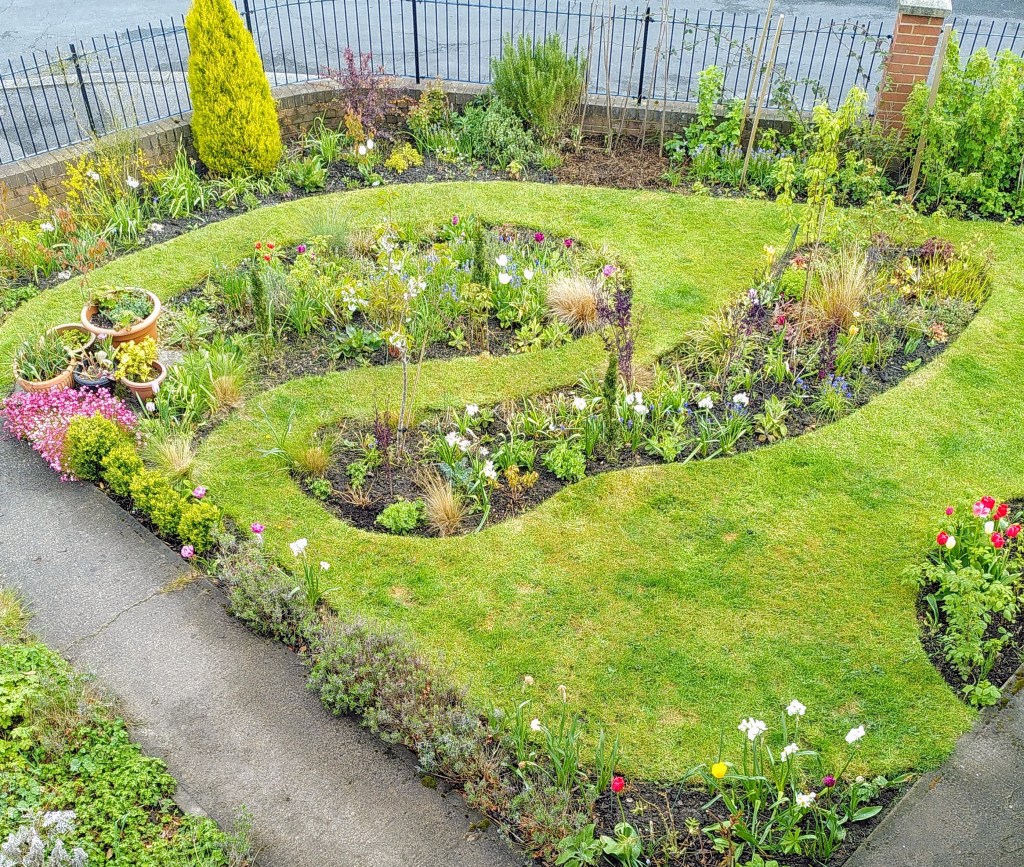
I have been gardening here, with limited skill and on a tight budget, for the last four and a half years. Each year has seen new projects, new plans made, adapted and sometimes forgotten, new strips of turf lifted to create new beds or enlarge existing ones. Almost everything I have planted is young and small – the process has come to feel like an act of faith in a future maturity that could well be someone else’s to enjoy.
Tending this small patch of land has been a joy. It has proved addictive but also healing, it has got inside me and changed me. For a long time, I have toyed at the idea of writing about my garden, or perhaps using my garden to write about other things. I have no real horticultural knowledge to impart; I am very much a novice, but my garden has helped me to think, and writing helps me to think. They hold together nicely.
I’ve been weighing up whether to write a blog for years now. I’m wary because the last thing the world needs is more noise. I’ve been reluctant to write for fear that I may not have anything worth saying. It’s quite possible that I don’t. But on the off chance that I do it seems worth a shot.
In the end though, this is quite a selfish exercise. I’ve found that writing is good for me and that I enjoy it. I want to do more of it, protect time for it, get better at it, and I hope that this blog might provide some degree of incentive to help me do that.

 Notes From the Potting Shed