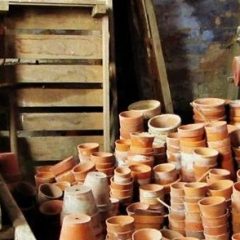
Well, the exile is over and I am back at my potting shed table. I am afraid that the blackbirds leaving their nest was not entirely smooth. Shortly after writing the last blog, there was a commotion in our back garden and I rushed to see the blackbird father flapping around a very near full-grown chick lying with a broken neck just outside the shed window.
I told myself that it is just a bird and that these things happen in nature, but I was still upset.
I don’t know what happened to the other chicks and I presume that is good news. There were three eggs when I first discovered the nest, and I presume the absence of any other casualties means that the other two chicks successfully made it out into the big wide world. Once we were sure that there was no more life in the nest, we took down the box of wood, braced for some unpleasant discoveries. To our relief, they had well and truly moved out and left everything neat and tidy.
It’s been an odd experience. Cohabiting with these birds has been a healthy pin-prick of reality to deflate my all-too romanticised view of the natural world. To a large extent, I have bought into a suburban understanding of ‘nature’ which sees ‘the environment’ in general, abstract terms – viewing the countryside as a place of leisure and beauty but from a safe enough distance to avoid the harsher realities of life in the natural world. As I set out on this journey of agrarianism – seeking after greater fidelity to creation, greater integrity to land and place and local community – I know that I have some painful unlearning to do. It will not be possible to truly care for creation in personal, holistic, non-abstract ways and remain insulated from the realities of death and violence.
But I don’t think the solution is simply to toughen up. I don’t want to replace romanticism with cold indifference to death and destruction. There is something in the sorrow I felt as I disposed of that broken little body – fresh-feathers ruffled and scrawny legs askew – something more than the squeamishness of a sheltered life, something that I think is good. It’s the deep sense that this is not the way that things should be.
Of course, a dead blackbird is a very trivial demonstration of the wrongness of things in our world. But it is still wrong, and in that moment, it got under my skin enough to lead me to place of grief. And I don’t do grief well. I have had the rare privilege of being able to opt out of grief through most of my life. Whilst that’s comfortable, I am coming to realise that it is not altogether good for me. Because grief – lament – is the right response to all that is wrong and broken in our world – whether something as small as a dead blackbird or as huge as wars and pandemics.
Numbness – borne of my unfamiliarity with grief – is a very useful defence mechanism – but it also limits my capacity to engage honestly with reality.
Perhaps then, this unexpected saga with the blackbirds in my shed has helped me to see a little clearer a small part of the journey ahead of me. As I re-root my imagination in the rich soil of agrarianism – as I learn to slow down, pay attention, settle for less, enjoy it more, be a good neighbour and embrace a deeper, more contemplative rhythm of life – I want to do so in a way that embraces rather than escapes the reality of death and violence in our world. I have a suspicion that my capacity to grieve may well be linked to my capacity to wonder and my capacity to love. I cannot grow only two of them – I need all three.

 Notes From the Potting Shed