Our son has been with us for just over a month now and so far adoption has felt a bit like jumping into a plunge pool – I knew intellectually what we were getting ourselves into, but no amount of thinking can prepare you for the gasping shock of going under the water.
Teething, a virus, and now all three of being down with covid has amplified what was always going to be a rough ride for the three of us. I feel stretched beyond limits I‘ve never really pushed before. To be ill when your child is ill, I have discovered, is brutal – especially when the double-whammy of building attachment and covid remove most possibilities of outside help. We’ve battled, with fevered and aching bodies, to help him sleep, knowing that the only chance of getting the rest we also need is in the fragile bursts where he is able to sleep through the pain he is too small to understand.
I don’t want to be overdramatic. We are ok. I think we are through the worst now and we have had moments of real joy too. I am sure that what we are experiencing is relatively normal for new parents, and far less complicated than the start of many adoptions.
I wonder, though, whether this is a bit of a purgation for me. Being ill, sleep deprived, and desperately trying to get this tiny stranger to stop screaming has dredged up the ugliest parts of me. I am confronted with the truth that for all I can present a kind and compassionate image – there remain deep areas within me that I am scared and ashamed of. I teach my students that the real test of character and leadership is who you are under stress and when no one is looking. I am not passing that test with flying colours.
All of which is bringing me face to face with the idol of competence. As idols go, it’s relatively benign and highly rewarded – it drives me to work hard and serve others. But the truth I can no longer avoid is that I have constructed a large part of my identity around being good at coping, at solving things, at producing good work. Which is all fine until I find myself – as I do now – pushed beyond what can be achieved by effort and planning and technique.
Which is why I am not desperate to move on from this stage. I’m looking forward to things settling down and to us all getting a bit more sleep, for sure. But I think, ultimately, this is good for me. I trust that God can use this time of pressure and stretching to do some deep, refining work to form me into who he has made me to be.
Painful as it is to have those ugly parts of my character exposed, I know that ignoring them won’t help or heal anything. Humiliating as it is to confront the idol of competence, like any idol, it is obstructing me from full, flourishing life in Jesus. So, it’s good to name it, and good to break its power.
But here’s the tricky bit. How do I break an idol of competence without relying on my own competence?
If my issue is an overreliance on my brain, strength and will-power in achieving my own self-improvement, how do I change that without relying on thinking, or working, or willing my way into change?
What does growth look like when my tried and tested methods of growth are the problem?
I sort of know where I want to get to: dependence on God – surrender to his will – a total reliance on Him and not on my own capacity, capability or creativity. But how do I get there without treating it like a problem to fix or a project to complete?
Surrender could mean something passive – just leaving it up to God to sort me out. But I worry that a passive understanding of surrender can become a sort of spiritual cop out absolving me of any responsibility for my own discipleship. I think God wants to involve me in the process rather than just zapping me into conformity.
My guess is that what I’m after is a sort of active surrender. I don’t know yet what exactly that means. Maybe some good first steps will be things like taking the small, daily decisions to yield, and to acknowledge my need, my dependence. To own the humbling failures and the new limits that come with having reduced capacity for work. To be present to God in the joys and anxieties of caring for a baby. To choose over and over to trust in God’s goodness and not my competence as the bedrock of by being and doing.
It’s funny, I have prayed for greater dependence on God for many years. I’ve been acutely aware of how easily I can make this whole discipleship thing a self-help project that relies too heavily on my own competence. I’ve made my bed, so I’d better lie in it. Painful and disorienting though this exposure and idol-shaking is, I want to seize this moment – not primarily with grit and will-power – but with gentle, humble embrace.
Since being matched with the child we will adopt, people quite often tell us how lucky this little boy is going to be to have us as parents.
They are always well-intentioned words spoken with great kindness. I am grateful for them. And yet, they jar a little.
Flannery O’Connor described sentimentality as ‘a distortion … in the direction of an overemphasis on innocence.’ I think that’s what I struggle with when people tell me that our little boy is going to be lucky. It’s an overemphasis on innocence.
It wasn’t long into the countless pages of reports, set on pale, austere paper that the option of sentimentality departed us. In the bleak assessments of wonderful, overworked social workers we encountered the world of chaos and pain into which this boy was born.
His being placed for adoption – that genealogical aberration, that ultimate severance – may be many things, but please don’t call it lucky.
I mean that as a gentle plea, not as an angry accusation.
To describe adoption as lucky does not honour his story. It ignores the unimaginable pain of separation that he is still too small to understand but feels all the same.
It also places a burden on us to be the heroes that we know we cannot be. I know that’s not anyone’s intention. I know people just want to affirm us and encourage us as we adventure into parenting – we certainly need that! But we are not heroes. We happen to have the stability, health, space and energy that makes adoption possible at this stage in our lives. We haven’t earned any of that. We are just doing what we think is right with what God has given us. If that’s heroic then we should be celebrating many thousands of other heroes who do the long, patient and unseen work of imperfectly attempting to be faithfully obedient to Jesus.
It’s going to be strange, in a few weeks, when we bring our little boy home for the first time. Beautiful, I’m sure, but unavoidably strange – to meet the one we have so far only known through pictures and words, to transition so suddenly from total strangers to closest relatives. We’re not expecting it to be easy.
I hope we will be the parents he needs. But he will not be lucky to have us. We will be the lucky ones – lucky to be entrusted with his care. Or maybe luck just isn’t the most helpful word – it’s too impersonal. We approach this not as entitled owners asserting our rights to this child, but as reverent recipients of a gift. We do not deserve him, but he is a gift which we will steward with gratitude and awe.
Woven in with all the bleakness and ambiguity, pain and challenge, there is an irrepressible thread of grace.
Since spring, we have been working our way through the adoption process. Through most of that period, it has all felt sufficiently distant for me to assume that I’ll probably just be ready for it when the time comes. But now that dates and decisions are getting quite close, I’ve been wondering if I need to be a little more proactive about getting myself as ready, mentally and emotionally, as I can be. So, I’m going to see if writing about it helps.
To be honest, as far as I can tell, it’s all just feeling very ambiguous.
On quite a practical level, there are all sorts of uncertainties, around matching and timing and most obviously around the particular needs of the child who we end up welcoming to our home. We know that this will dramatically change our lives, but we have no idea quite how. We know that it will be really hard, but we have no idea how hard.
Then there are the uncertainties that I imagine all new parents feel around our capacity and preparedness to be the attuned, nurturing carers that this child is going to need. We are bringing all of our idealised hopes of the sorts of parents we want to be, all of the baggage (good and bad) that we carry from our own upbringings, all of reading and learning that we’ve been ploughing through. And we have no idea if it will be enough. We have no idea if we will be up to the task. For two high achievers who struggle with perfectionism, this is all a bit uncomfortable.
And combined with all of those uncertainties is the ethical ambiguity of adoption itself – at once so beautiful and so tragic, so redemptive and so deeply wounding. The more we learn about trauma and attachment, the more cautious we are of seeing adoption as anything more positive than the least bad option for children in dreadful situations. I think we need to sit with the uncomfortable reality that by adopting we are participating in the breaking of bonds that ought never to be broken.
Of course, we remind ourselves, adoption will be the last resort for the child that is placed with us. There are children who need a safe home and loving family – and we hope we can give that. But we’re feeling the brokenness of it all – the cycles of trauma and abuse, the entrenched generational injustices, the chaos, the bleakness, the poverty of love, the unimaginable grief and shame and powerlessness that must come with having a child removed from your care.
Hard as it is, I think it’s right that we sit with all the brokenness and that we look it in the eye. It forces us to interrogate our own motives, it heightens our sensitivity to any hint of a saviour complex and it makes us wary of telling an adoption narrative that is all neat and saccharine and happily ever after.
So, as I say, lots of ambiguity. But right now, sitting at my desk on a grey October Saturday, that ambiguity feels alright. I’m feeling it, for sure, but it’s not heavy or debilitating. It feels contained – tethered and held in check – present but not dominant.
It brings into sharp focus what is probably true of all life this side of new creation – that clunky juxtapositioning of joy and pain, redemption and brokenness, beauty and tragedy. Life is ambiguous, uncertain and mostly out of my control. This has always been the reality, our adoption journey hasn’t altered that. But what getting ready to adopt has done is remove the option of insulating ourselves from that reality. That’s not easy, but I trust that it is good.
When I think about vocation – what to do with my life – I find myself compelled by two paths that seem to lead in quite different directions.
I’ll call one path the way of service. This is a school of thought that seems to be especially common in more missional and activist spaces and seems to set most comfortably with more utilitarian or reformed worldviews. The heartbeat of the way of service is that the purpose of my life is to give myself away, laying down my ambitions and sacrificing my pleasure for the good of others. Popular slogans for this way of approaching vocation often sound like they come from a gym or a battlefield, include things like: ‘Don’t waste your life,’ ‘Do all the good you can,’ ‘Fight the good fight,’ ‘Spend yourself on behalf of the hungry,’ ‘Push right to your limits,’ ‘Leave nothing on the field.’ It’s a path that might lead people to incarnational mission in a rough area or working a particularly demanding job or practicing radical simplicity in order to give generously.
The other path is the way of wholeness. This is a school of thought that is perhaps best exemplified by the likes of Wendell Berry and Eugene Peterson and is more popularly championed by a lot of the books about rest, self-care and emotional health that have come out in the last decade or two (many of which seem to be reactions against some of the more extreme aspects of the way of service). The way of wholeness is all about integrity and character-formation. It cares more about being than doing. It values rest, limits, creativity, art and beauty. On the way of wholeness, it is ok for something to be a good in itself – not everything needs to be a means to an end. It is a path that leads people to value family life over their careers or local neighbourhoods over upward mobility or slowness and fullness over speed and achievement.
On the surface, these feel like divergent paths pulling in very different directions. And that’s what I find difficult, because though there are some very attractive parts to both paths, there are also significant dangers.
I love the other-centredness, the sense of purpose and the missional drive in the way of service. I want my life to count, I want to serve others like Jesus does and that means that there will be cost and suffering. But I also recognise dangers in the way of service – dangers of scraping through life stressed, joyless and frantically busy, dangers of indulging messiah complexes or creating dependencies, dangers of baptising a thoroughly secular workaholism and addiction to results, dangers of neglecting my own health and formation, dangers of hurting those I love in the name of serving God.
And on the other hand, I love the depth and the slowness of the way of wholeness. I love the value it places on being, not just doing. I love the space it creates for character formation and rest and beauty. I love the respect it has for humans as whole beings. I want to live a life that is full, and thriving, and sustainable. I want to grow into a disciple of maturity, peace and joy. But I also recognise dangers in the way of wholeness – dangers of mistaking self-care for self-absorption, dangers of slowly drifting into a comfortable life of consumption and middle-class affluence, dangers of opting out of anything that might be costly or hard, dangers of unrealised potential, dangers of living a life that is closed in on itself and withdrawn from the world.
Both paths are good. Both pick up on clear traditions within scripture and throughout church history. But either path, pursued in isolation, is problematic.
And so surely the answer is some sort of creative tension – a third path – one which keeps both paths within sight but refuses to veer too far towards one at the cost of losing track with the other.
It’s one thing to identify that tension in theory. But I am entering a stage of life now where suddenly there are quite a few big decisions to be made. I want to live on purpose – by design not by default. But that is hard when the path you want to take is the tricky way of tension and negotiation rather than the superficially frictionless paths of either extreme.
It’s good to know that we are not on our own. It’s good to know that there are others who have held this tension before us, who have lived lives where service and wholeness harmonise and reinforce each other. That certainly helps. And whilst there are big decisions that feel far too ‘adult’ for me to make, I have a suspicion that the actual business of holding the tension of service and wholeness will happen primarily in the day-to-day, in the mundane, in the small things. That removes some of the fear from those big decisions. It also brings all of this down from the future and the theoretical level to the more immediate and tangible, more containable level of who I am choosing to become today. That’s where we carve out this third path – that’s where the adventure is.
In Sabbath as Resistance, Walter Brueggemann writes about the restless anxiety and violent competitiveness that proliferates in society. ‘The totem,’ he says, ‘of such restlessness is perhaps professional sports … The endless carnival of those sports constitutes a dramatic affirmation of power, wealth, and virility in which “victory” is accomplished by many abusive exploitations, all in pursuit of winning and being on top of the heap of the money game.’[1]
When I first read it a few years ago I mostly dismissed it. This, I thought, is probably a bit of an American thing that doesn’t really apply to me. Surely, I can enjoy a bit of professional sport and still practice sabbath, still resist the culture of restless anxiety and live into God’s alternative values of neighbourliness, justice and rest.
But something from my initial reading clearly lodged in my mind and it has come to the fore over the last few weeks. We’ve had quite a summer of sport – the football, the rugby and the Olympics have all drawn me in. I’ve had excited conversations with friends, eagerly awaited player ratings and team selections, watched analysis and read punditry – all of it on a level that I don’t remember doing before.
I’ve tried to be sensible and retain some boundaries, particularly around work, but that has simply meant that my rest and weekends this summer have largely been dominated by the consumption of ‘the endless carnival’ of professional sport. I do not think that is necessarily a bad thing in itself and there certainly have been moments that I have enjoyed. But there have increasinly been moments where I have wondered about the influence this is all having on me. If we become what we give our attention to, then how is this consumption of sport shaping me? Who is it forming me into?
My relationship with sport has always been a little complicated. Growing up, I got fairly seriously into a number of sports. But I don’t know if I’ve ever really enjoyed playing sport. I enjoyed the winning, but I’m not sure I especially enjoyed the playing in a purer sense. The angry tears that would often come if I made a mistake on a football pitch may just about be a thing of the past, but that unpleasant competitive edge has carried from playing sport as a teenager into the more vicarious world of consuming professional sport as an adult. For whatever reasons, I seem to have especially struggled this summer. When England lost the Euros and when the Lions lost the test series my sleep was affected for days. What does it say about my priorities when I don’t lose a wink of sleep over a drug overdoses on our estate, but a few jaw-droppingly wealthy men, a ball and the inevitable ability to over-promise and under-deliver can wreck my body’s rhythms?
The capacity professional sport has to affect my mood and command my attention worries me. And so does the anger that I’ve felt – whether directed at players, coaches, officials or other nations. Again, the questions come: ‘who is this forming me into?’ ‘what in me is being appealed to here?’ Surely what is being appealed to are ugly, broken, unkind parts of me that need deep work, not casual encouragement. Surely, I am not being formed into a person of love, character, depth and integrity. Instead, I am being formed into someone who is angry, tribal and distracted – abdicating from the risk and pain of engaging meaingfully in the reality of the world and instead vicariously simulating that risk and pain through the narcotic satiation of commodified sport.
So, I have a bit of a decision to make. Do I look for ways to engage with professional sport more healthily? Or do I do something a little more extreme and abstain? I’ve tried not watching matches live but find that I just end up anxiously refreshing the live updates on BBC which may only be marginally less stressful and distracting.
And so, reluctantly, I want to experiment with something more severe. If Brueggemann is right, (it’s probably time I admitted that he might be onto something) then the practice of sabbath is the appropriate resistance to the competition, consumption and distraction glorified by professional sport. So, it is time for a sabbatical – a fast – a divestment from a form of entertainment that has been a significant part of my life for as long as I can remember.
I don’t like who I become when I consume sport. It brings out the worst in me, not the best. This might not be the solution – it could be an overreaction, but in the absence of better ideas I think this is worth a try. For the rest of this year, I am committing to be deliberately inattentive to scorelines, headlines, transfer rumours and highlights.
I will give some thought to what I do instead – old habits die hard so I am not expecting this to be easy. I expect it will be helpful to see this less as giving up something I quite like, and more as choosing something better.
‘Sabbath is a practical divestment so that neighbourly engagement, rather than production and consumption, define our lives.’
Walter Brueggemann, Sabbath as Resistance, 18
[1] Walter Brueggemann, Sabbath as Resistance: Saying No to the Culture of Now (Louisville: John Knox Press, 2017), pp. 15-16
Well, the exile is over and I am back at my potting shed table. I am afraid that the blackbirds leaving their nest was not entirely smooth. Shortly after writing the last blog, there was a commotion in our back garden and I rushed to see the blackbird father flapping around a very near full-grown chick lying with a broken neck just outside the shed window.
I told myself that it is just a bird and that these things happen in nature, but I was still upset.
I don’t know what happened to the other chicks and I presume that is good news. There were three eggs when I first discovered the nest, and I presume the absence of any other casualties means that the other two chicks successfully made it out into the big wide world. Once we were sure that there was no more life in the nest, we took down the box of wood, braced for some unpleasant discoveries. To our relief, they had well and truly moved out and left everything neat and tidy.
It’s been an odd experience. Cohabiting with these birds has been a healthy pin-prick of reality to deflate my all-too romanticised view of the natural world. To a large extent, I have bought into a suburban understanding of ‘nature’ which sees ‘the environment’ in general, abstract terms – viewing the countryside as a place of leisure and beauty but from a safe enough distance to avoid the harsher realities of life in the natural world. As I set out on this journey of agrarianism – seeking after greater fidelity to creation, greater integrity to land and place and local community – I know that I have some painful unlearning to do. It will not be possible to truly care for creation in personal, holistic, non-abstract ways and remain insulated from the realities of death and violence.
But I don’t think the solution is simply to toughen up. I don’t want to replace romanticism with cold indifference to death and destruction. There is something in the sorrow I felt as I disposed of that broken little body – fresh-feathers ruffled and scrawny legs askew – something more than the squeamishness of a sheltered life, something that I think is good. It’s the deep sense that this is not the way that things should be.
Of course, a dead blackbird is a very trivial demonstration of the wrongness of things in our world. But it is still wrong, and in that moment, it got under my skin enough to lead me to place of grief. And I don’t do grief well. I have had the rare privilege of being able to opt out of grief through most of my life. Whilst that’s comfortable, I am coming to realise that it is not altogether good for me. Because grief – lament – is the right response to all that is wrong and broken in our world – whether something as small as a dead blackbird or as huge as wars and pandemics.
Numbness – borne of my unfamiliarity with grief – is a very useful defence mechanism – but it also limits my capacity to engage honestly with reality.
Perhaps then, this unexpected saga with the blackbirds in my shed has helped me to see a little clearer a small part of the journey ahead of me. As I re-root my imagination in the rich soil of agrarianism – as I learn to slow down, pay attention, settle for less, enjoy it more, be a good neighbour and embrace a deeper, more contemplative rhythm of life – I want to do so in a way that embraces rather than escapes the reality of death and violence in our world. I have a suspicion that my capacity to grieve may well be linked to my capacity to wonder and my capacity to love. I cannot grow only two of them – I need all three.
Years ago, when I shared this house with three other guys, we were very kindly given a sixteen-foot shed. We didn’t need anything so big, but friends were getting rid of it, and we didn’t have any other offers. Over a number of weeks, we disassembled it and then did the best our limited carpentry skills would allow us to put it all back together in our back garden where, aside from the occasional collapsed roof, it has remained, rickety and patched up, but undeniably spacious. It is a nice place to be when it isn’t too cold. We have an old dining table in there. When I want a change of scene, away from distractions and beyond the reach of wifi, I sit there and write. Hence, notes from the potting shed.
A few weeks ago, however, I discovered that I had guests in the potting shed. A couple of blackbirds had decided to build a nest on top of a cardboard box filled with wood I was drying for the fire pit. Either they had built it very fast, or I was spectacularly unobservant for a while because when I discovered the nest it was fully constructed. And they had laid eggs.
I panicked a little when I saw the eggs. Haunted by childhood memories of baby blackbirds attempting flight prematurely and meeting a messy end on the pavement outside our house, I decided I needed to ring my mum for advice. Much, I am sure, to the relief of the blackbirds, she told me that I must not move the nest, and that I should give them as much space as I could.
So that was that. A summer of writing at my shed table written off because some blackbirds had lazily mistaken a box of twigs in a shed for a nice regular tree. I’ve done my best to be generous to the squatters – using an old dust sheet to partition the shed off – their half and my half.
Mild inconvenience though it is to cede half of my shed to a couple of birds with dubious taste in nest-making, Mr and Mrs Blackbird have steadily won me over to their cause. They work tirelessly and selflessly for their young. I oversaw one particular act of heroism when the dominant cat of the neighbourhood came prowling along the nearby fence. This is not a cat to be messed with – I have seen him fighting the other cats in the neighbourhood off so that he can claim exclusive toileting rights to my garden. But Mr Blackbird’s screeches and repeated divebombing saw the cat beat a hasty retreat when he ventured a little too close to the nest.
From the endless supply of worms that Mr and Mrs Blackbird are now bringing into the shed, and the tiny chorus that greets their entry, it seems that the eggs have hatched over past few days. I cannot help but admire the tenacity and nurture of these parents. They have slowly worn away my frustration at the inconvenience of it all and I’m finding myself really quite emotionally invested in their survival. We will see what the coming weeks have in store.
I am the kind of person who really enjoys being productive and who reads books about time management for fun. I get a kick out of doing things well and fine-tuning my habits to get more stuff done. I also really enjoy talking with and teaching others about time management, and I get excited about the untapped potential that could be unleashed through helping people get organised and productive.
But for a while, I’ve been growing a bit uncomfortable with my own teaching. The tools that I enjoy telling people about seem to work. And the writers who I have adapted those tools from have a lot of very helpful things to share.
My worry is deeper than that. It concerns our imagination; the assumptions we make about time itself. I believe that we, in the west, tend to approach time with imaginations that are shaped by the dominant ideas around us, notably: capitalism, consumerism and individualism.
That might all seem very abstract, but I fear that the results of approaching time with imaginations shaped by the dominant culture are all too concrete and all too destructive. If our imaginations – our mindsets – give us the raw ingredients with which we think about time, and if we repeatedly do not like the end products we are getting, then I’d suggest that the best course of action is not to try another combination of the same ingredients, but to source alternative ingredients – an alternative imagination.
To help with this, I am going to draw on the work of the farmer, poet and writer Wendell Berry. His contrarian voice may help us in our search for an alternative imagination. In his essay, The Agrarian Standard, Berry asserts that ‘the most fundamental human difference’ in our society is between the mindsets of industrialism and agrarianism. Industrialism is utilitarian, greedy and impersonal, agrarianism is local, reverent and limited. To put it more crudely one is the mindset of the factory, the other is mindset of the farm.
I wonder if these two mindsets can helpfully be applied to our thinking about time and productivity.
I think that our overwhelming tendency when we think about time and time management in the western world is to do so within what Berry would call an ‘industrialist’ mindset. Berry describes some aspects of the industrialist mind which map scarily well onto how we tend to think about time and time management…
i) To industrialism, all value is utilitarian (where something’s value is about how useful it is.) So, to the industrialist, time is a commodity to be used. How we use time determines its value – think about how easily we talk about making good use of time or wasting time – in the same way that we might make good or bad use of fuel or materials or money. If that’s how we think of time – as a commodity to be used, time management becomes a matter of extracting the greatest use from the minimum amount of time.
ii) ‘Industrialism prescribes an economy that is placeless and displacing,’ this means that time is detached from place and from community. Time is no more than an abstract concept – unconcerned with matters personal or local. To an industrialist mind, things like love, beauty, sacrifice and community have no role in time management – they probably just get in the way.
iii) Following from that, Industrialism encourages us to engage with the world in fragments. Think how easily we divide work and life (or work/life balance) as though there is a hard boundary between working and living. We often do the same in the Church when we divide the secular and the sacred. Some units of time are for God – perhaps a Sunday service, or a devotional time – but the rest, by implication, is not really God’s concern.
iv) Industrialism believes that ‘abundance comes from the violation of all limits.’ And if limits like our bodies, our energy, our calling, are there to be transcended, time management, becomes a matter of ever-expanding conquest – of continual growth and the destruction of all boundaries. It is no surprise, when such ideas dominate, that so much time-management literature is about ways of overcoming limits – of restlessly increasing our capacity. To some, even sleep is treated as an impediment to maximal productivity which we can overcome with the right technology.
v) Finally, industrialism is concerned with quantity over form. Berry describes ‘the wheel of technological progress,’ where insatiable desire for more feeds an overwhelming sense of incompleteness, which in turn feeds a desire for more. This vicious cycle leaves victims of industrialism constantly seeking more and never satisfied. It also results in terrible ugliness, violence and waste. I wonder if this affects many areas of life as dramatically as it affects our relationship to time. The prioritising of quantity over form – of volume over value – leaves us franticly busy and perpetually unsatisfied. However hard we work, enjoyment is evasive. There is always more to do, always new levels to hit, always new goals to achieve. This relentless drive for more turns time into a competitor to struggle against. It does great violence to our physical, emotional, spiritual and social health. When we care more about the quantity of stuff we produce than we do about the form (the true quality, the true value) of what we produce, it drives an economy that relies on greedy extraction, the unrestrained abuse of creation and the misery of the poor.
This might all seem a bit extreme, but the more I’ve thought about it, the more I’m convinced that how we think about time and productivity really matters. This industrialist understanding of time management can produce some decent results – it can help us produce more – but at terrible cost, to ourselves, to our communities and to our planet.
II.
For as long as we are operating within an industrialist mindset, our understanding and practice of time management will probably help us feel quite productive in the short term, but at great cost – to ourselves, to others, and to our planet. Before we explore the alternative mindset that Berry offers, I want to dwell a little more on how we think about time as followers of Jesus, since it is so foundational to all else that follows. Here we turn to the work of John Swinton.
John Swinton is a theologian up in Aberdeen.
As far as I’m concerned, anyone who titles a book Becoming Friends with Timeprobably has some interesting stuff to say. I am not going to do justice to his work in a quick summary, but here goes…
Swinton talks about viewing time as God’s time. He points out that before clocks appeared in town squares and then in factories, clocks existed in monasteries. They dictated times of prayer. The particular events that the clock scheduled had to do with holding and shaping the day in such a way that sacred values, spiritual concerns and mundane issues could be seen as occurring within God’s time and according to God’s purpose.
When clocks spread beyond monasteries, and in particular with the invention of the second hand and the rigid work schedules of factories, time, says Swinton, became co-opted by capitalism. Time stopped being for God and time became about money. The idea resonates really clearly with what Wendell Berry says about how the industrialist mindset turns time into a commodity to be used.
And remember how the industrialist mindset views time as an enemy to compete against. Contrast that with Swinton’s beautiful phrase ‘becoming friends of time’. Becoming a friend, not an enemy, of time, he says, requires that we shape our lives and communities in ways that will enable God’s people to participate faithfully in Jesus’ redemptive work in time. For Swinton, God’s time is created, gifted, slow, generous, gentle and designed for love. God’s time dictates the speed of love; it refuses to race past those who are moving more slowly. Much of the book focuses on cognitive disability –and his core point is that if our discipleship moves so fast or is so efficient that we exclude people with cognitive disability from participating, then we have also left Jesus behind.
‘Recognizing time properly is a movement away from idolatry and violence toward faithful timefullness. Those who are made in God’s image have time for one another. To give generously of one’s time – to care, notice, value, and appreciate time – is to adopt the attitude of Jesus and to begin to tune one’s body into the cadence of God’s time and the redemption of all time.’
Reading that sort of thing leaves me feeling torn. There is a part of me that is hugely attracted to the beauty of it, but the more pragmatic workaholic in me worries that this just becomes a licence for chaos, for glorified inefficiency, for laziness. But this is different from laziness. Laziness, says Swinton, is the deliberate attempt by human beings both to own and to waste time. Laziness is opting out of faithful participation in God’s redemptive mission.
There is a difference between valuing the slowness of our bodies and our minds and living lives that deliberately scorn the gift of time. I think it is a subtle difference – I don’t pretend I have got it figured out yet. It doesn’t help that the dominant industrialist imagination of our culture provides us with no categories for understanding or valuing those who live slowly and gently at the speed of love. Industrialism cannot distinguish between laziness and timefulness. We need a renewed imagination, a different mindset.
To summarise Swinton’s view of time: time is a gift, given out of love. Time is not something we can master. Instead, time is for love. Time management is therefore about love. We can stifle that love either by being frantically busy, or by procrastinating and withdrawing from meaningful action.
III.
Having critiqued an industrialist understanding of time using Wendell Berry and John Swinton, it’s clear to me that we have a problem. But is there a viable alternative?
To draw on theologian Walter Brueggemann and the Exodus story in the Hebrew Scriptures, industrialism is the way of Pharaoh – it is the way of restless anxiety and relentless consumption. It reduces time to a commodity and neighbour to a competitor. It leaves no space for love or tradition or community, and it excludes those who move more slowly in the world.
We need what Brueggemann would call prophetic imagination – new words and symbols that give language to an alternative way of being with time and ‘becoming friends of time.’
Wendell’s Berry’s alternative is not a shiny new revolutionary worldview – it is a mindset, present on the margins of history for millennia, a mindset that steeped the lives and imagination of many if not most of the biblical authors. It is the mindset of agrarianism – the imagination of those communities on the rural margins, whose way of life has become increasingly mocked, ignored and placed under threat by our industrialised economies.
It’s easy to write Berry and other agrarian writers off as relics of a lost past, clinging nostalgically to some romantic pre-industrial utopia that never really was. But I think that is a lazy and incorrect characterisation.
The agrarian view of creation is grounded, local, and real. Farming is hard – with little room for romanticism or sentimentality. I wonder if accusations of sentimental view of the land are far more justifiably aimed at suburban middle-classes – who care a lot about things like nature and the environment in general, abstract terms – and perhaps enjoy the countryside as a place of leisure or tourism – but without any the intimacy or realism or fidelity of those whose lives and livelihoods are bound to the land in a relationship of multigenerational commitment and care.
Agrarians are not the romantics.
The alternative Berry offers is more than rose-tinted nostalgia. Agrarianism is a deeper, fuller, and, I would argue, profoundly more biblical way of understanding our place in God’s time. It’s made me massively reconsider how I relate to time.
Remember those five characteristics of the industrialist mind that I’ve adapted from Wendell Berry:
The industrialist mind:
turns time into a commodity to be used
is placeless and displacing
breaks the world up into fragments
believes that abundance comes the from violation of all limits
is concerned with quantity over form
Let’s contrast each of those with the agrarian mind:
i) The agrarian mind sees human beings as caretakers of something they did not make. Time, therefore, is not a commodity to use and exploit for maximum profit, but a gift to be received with joy, gladness and reverence.
ii) Time, to the agrarian, is a common good – given for the benefit of all people. That means that the way we steward the gift of time cannot be a matter of competitive individual striving, but a community exercise, if which no one is left behind. According to theologian Ellen Davis, the idea in the Hebrew Scriptures of nahala – or possessing the land – is not only, and maybe not primarily, about conquest but also about care. I wonder if that transposes onto time? An agrarian’s relationship with time is less about conquest and more about care – caretaking – as custodians of a gift.
iii) Agrarianism sees time as a unitary whole. Rather than being fragmented and divided, time is integrated – wholeness and fullness of time become the aim. In How to be a Poet, Berry writes that ‘there are no unsacred places / there are only sacred places / and desecrated places.’ I wonder if that transposes from place to time, and if we could equally say that to the agrarian mind, there is no unsacred time, only sacred time, and desecrated time? If that carries, then the popular idea of giving God a fragment of our day (even the best bit of our day) is problematic. That’s not to say we should dispense with spiritual rhythms, but it ought to move the goalposts. Starting the day with quiet time might be very good but it is not the aim. Living in God’s time, for the agrarian, surely means learning to dispense with any sacred/secular divide and living with an alertness to God’s presence and resurrection power in the present moment – however mundane or everyday that moment may be. It reminds me a bit of Brother Lawrence’s idea of practicing the presence of God.
iv) In agrarianism, limits matter. Agrarians know all too well the destruction – to land, bodies and community – that comes when farming has been co-opted by the industrialist addiction to transcending limits. James Rebanks, in English Pastoral, describes well the devastation wreaked on both sides of the Atlantic by industrial farming. In full knowledge of the damage that comes with the cult of ‘bigger is better’, the agrarian imagination is content to live within natural limits: valuing integrity, simplicity, family coherence, neighbourliness and local economies.
v) In direct contrast to industrialism, agrarianism is concerned with form over quantity. How we produce is more important than how much we produce. Living in time is not a mechanistic matter of efficiency, it is an art. It is about the value, not the volume of our work. The aim is wholeness, completeness and holiness.
With all of that in mind, it’s time we grounded this all a little more practically.
IV.
I’ve raised some of the deep problems of understanding time through the lens of an industrialist imagination and I’ve begun to offer one alternative way of seeing the world and being in time: the agrarian imagination. But this isn’t all a prelude before landing on some snazzy new tool for productivity and time management.
To an industrialist, tools are about utility and efficiency – means of producing greater output with lower input. But agrarians also have a place for tools, they just perceive of them differently. To agrarians, tools are carefully selected – they are about longevity, simplicity and skill.
All that to say, I am not against time management tools. Whether we should use any tools to help us get stuff done is the wrong question, because we all do, it’s just that many of us have habituated the use of bad time management tools without thinking about it. The right questions, I think, are how we decide which tools to use, and how we use those ones we pick.
So, I am not proposing any snazzy new tools or techniques for getting organised and productive. But I do want to end with a few thoughts on how an agrarian imagination could influence the way that we pick and use many of the existing tools that are in wide circulation.
For followers of Jesus, like so much in discipleship, this is a matter of congruence. Eugene Peterson said that the Christian life is ‘a lifelong practice of attending to the details of congruence.’ By congruence, he means things matching up. In particular he talks about the importance of congruence between what we do and the way we do it. It’s dangerously easy to do the right things but in the wrong way. It’s easy to be right about what we do, but wrong about how we do it.
It is easy to do all the right stuff when it comes to productivity but to do it the wrong way.
We can be brilliant at week reviews, and using our calendars, and deep work, and prioritising what is important and not urgent, but still treat time as a commodity to use and exploit, or treat time in fragments divided into sacred and secular, or find ourselves in a frantic effort to violate our God-given limits, or move at a pace that is incompatible with love.
We can do all the right stuff but in the wrong way.
So what?
If we are to attempt to uproot our imaginations from industrialism and re-root in agrarian soil, the implications will necessarily spread far beyond our approach to time and productivity. I want to do more thinking about how all of this spills out into other arenas of life, not least how we approach work. But for now, let’s land this where we started: with our practice of time management and productivity.
An agrarian imagination could lead us to approach time management in the following ways:
We plan each day with care. Prioritising tasks becomes a way of accepting our limits, of choosing value not volume. I can’t do all of the good things that I’d like to do today, but I can do a few things, and I am going to do them well – valuing form over quantity.
We use our calendars as a way of carving out time for what really matters as well as allowing margin in our days so that we are not moving too fast to love people, so that we can greet unexpected interruptions as a gift not an annoyance.
We rest well not as a means to an end, not in order to work harder tomorrow, but because we are living in God’s time and God’s time is unhurried. The salvation of the world does not depend on our frantic activity. We rest as an act of resistance to the dehumanising demands of the industrialist imagination, and as an act of trust in God’s redemption of all things.
We build whatever practices we need to minimise unhelpful procrastination, not because we’re anxiously obsessed with avoiding time wasting and we don’t like to have fun, but because we recognise that time is a gift, and that time is for love, and that excessive social media, or gaming, or nervous news reading (my current procrastination of choice) – especially when it is addictive and competing for our attention – isn’t helping us become people of love.
We guard time for deep work and limit the time we spend responding to notifications and with our inboxes open in tabs on our screen, not because we are trying to outcompete our colleagues, but because we are focusing our attention on what matters most, meaning that we are more fruitful, and we love each other well by producing good work.
We do week reviews, in a way and a rhythm that suits us, not because we’re striving each week to seize total control over our schedules, but as a practice of reflection – no less ‘spiritual’ than an hour of prayer – that recognises the gift of time, that learns from the week just gone, and maps out the week ahead in a way that will best enable us to be fruitful – to love God and to love others.
We say no to a lot of things – even a lot of good things – because we recognise and respect our limits. That means that we will sometimes disappoint people. But the alternative is slavery to frantic busyness that comes from trying to transcend our limits. An agrarian imagination allows us to be clear on what is most important and it equips us to say no to other things without guilt. It weans us off the fear of missing out by grounding us in the personal and the local.
Ellen F. Davis, Scripture, Culture and Agriculture: An Agrarian Reading of the Bible (Cambridge: Cambridge University Press, 2009)
Eugene Peterson, Christ Plays in Ten Thousand Places: a Conversation in Spiritual Theology (London, Hodder & Stoughton, 2005)
John Swinton, Becoming Friends of Time: Disability, Timefullness and Gentle Discipleship (London: SCM, 2017)
Wendell Berry, ‘The Agrarian Standard’ and ‘Quantity Versus Form’, in Wendell Berry, The World-Ending Fire (London: Penguin, 2018)
Wendell Berry ‘How to be a Poet’, in Wendell Berry, The Peace of Wild Things (London: Penguin, 2018)
I live on a social housing estate in the North East of England. The estate was built in the thirties – all red brick terraces arranged around a central roundabout like spokes in a buckled wheel.
Houses on the estate come in two designs. Ours is of the simpler design – the economy class, I suppose – two up, two down, except that one of the two upstairs rooms has been divided into what you could probably get away with calling separate bedrooms, provided you don’t require space for any furniture in addition to the bed.
When I first moved to the estate, I spent a year sleeping in one of the smaller rooms. I decided that I would like to have somewhere to store my clothes and so compromised: opting instead for a futon rather than a single bed, which fitted me perfectly provided I slept at the correct angle, with my body on one side to avoid the wooden joint in the centre and my legs slightly bent. I actually got quite used to it.
Though marginally bigger, the adjoining half-bedroom has a redundant chimney breast jutting out which means that if you want to fit a bed in the room and still be able to open the door, you have a choice between creating two inaccessible alcoves by placing the bed against the chimney breast, or putting the bed against the radiator and preventing what little heat it is able to produce from warming the room.
I occasionally image myself designing a little bed that folds up vertically into one of those alcoves, like Professor Calculus in the Tintin books, but I have so far lacked the Professor’s engineering skills or leisure time.
Nothing about the house seems to have been designed by someone who had any concern for the future occupants. All of the radiators are directly below windows, so the heating is inefficient and expensive. The south-facing windows are small while the north facing ones are big, meaning that the house gets little natural light and is often colder inside than out. They are double glazed, but grime and condensation sit permanently between the panes. Under the stairs is a tiny room with a toilet but no sink. Upstairs, we had to install our own shower – the house did not come with one. Oh, and neither did it come with carpets, fridge, washing machine or oven. It turns out that the housing association has a policy of totally and inexplicably gutting a house before a new tenant moves in. Quite why they think it is a good idea to present a single mum or an elderly couple with bare floorboards and crumbling plaster and a gas meter jammed off until a safety check in arranged is beyond me. Perhaps the problem is precisely that they don’t think about it. It is an extractive system – designed to squeeze maximum rent out of these rickety old houses with the minimum cost or effort. Why would such a system see any value in personal connection, or local knowledge, or a job well done? None of that makes sense when you can just outsource responsibility to underpaid and overworked operatives in distant call-centres.
In many ways, this house is a testament to a thousand ‘efficiencies’ and cut corners by distant organisations who cared more about their bottom-line than about good work, or good sense, or compassion.
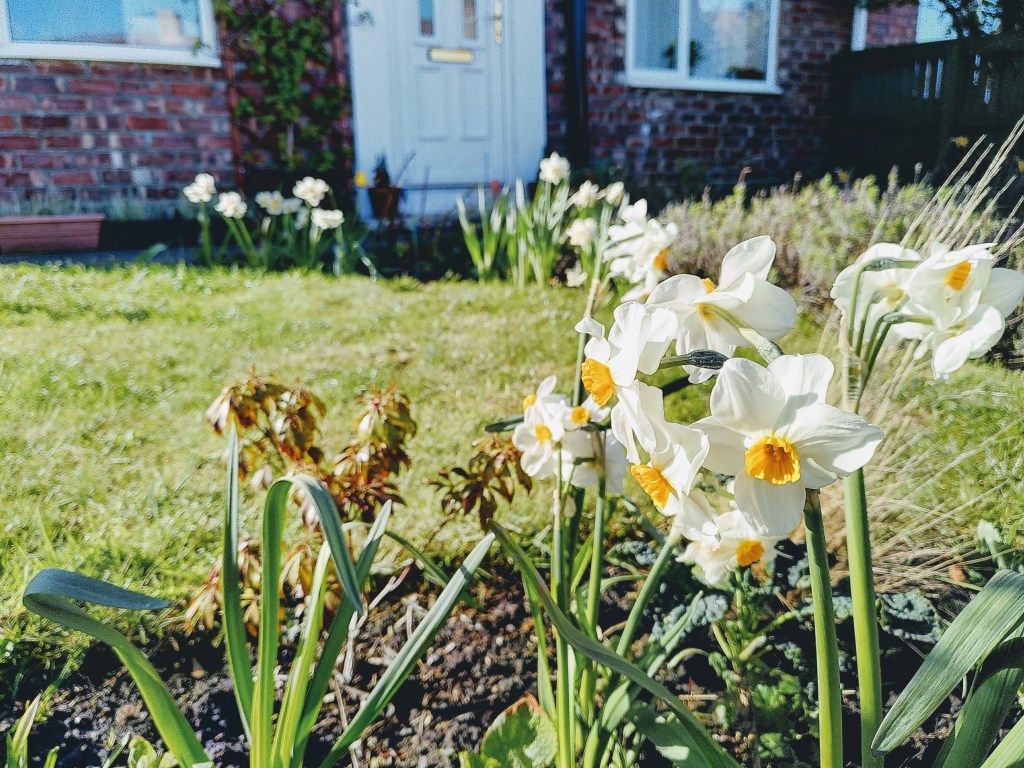
Yet, for all of its flaws, we have made this house our home. It has felt like a victory hard won but assisted hugely by the house’s greatest redeeming feature: the garden. Most of it sits in the shade of the windowless northern wall of the house and it has little protection from the cold winds that tear in from across the nearby fields. The clay soil may be layered with generations of plastic waste but it is dark and rich. The plot is a decent size, and it is ours.
It sits in the shade of the house with little protection from the wind. But the clay soil is rich, the plot is a decent size, and it is ours.
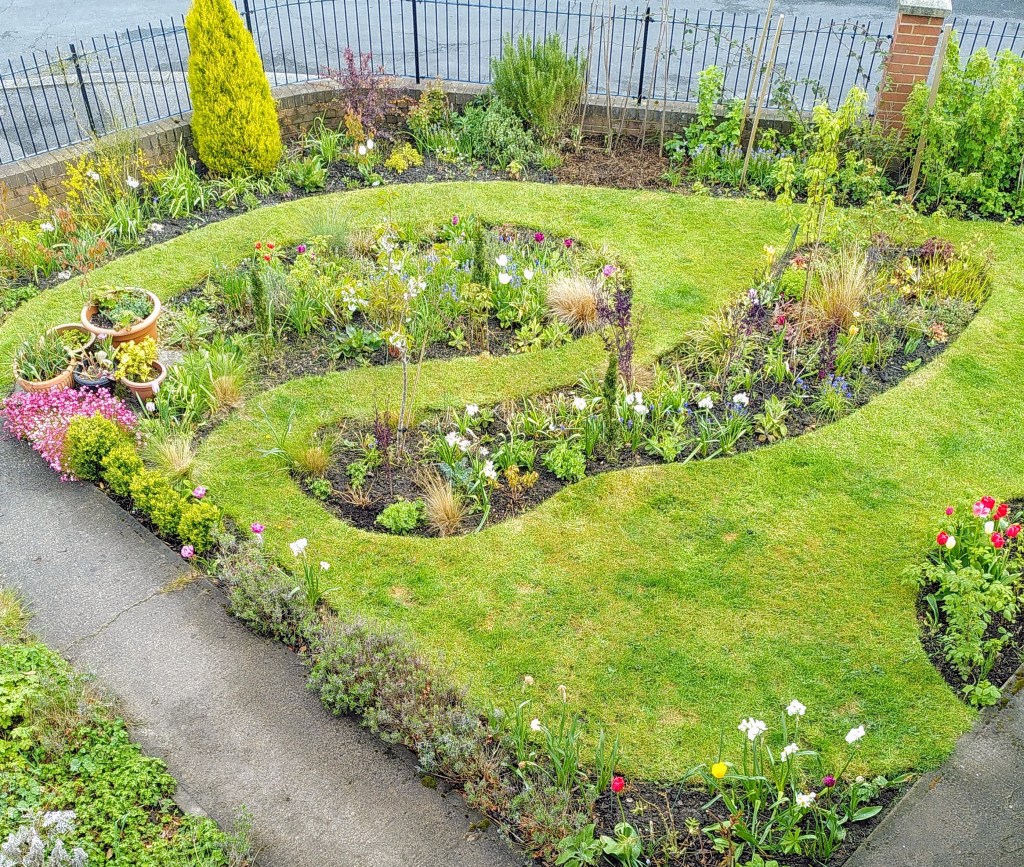
I have been gardening here, with limited skill and on a tight budget, for the last four and a half years. Each year has seen new projects, new plans made, adapted and sometimes forgotten, new strips of turf lifted to create new beds or enlarge existing ones. Almost everything I have planted is young and small – the process has come to feel like an act of faith in a future maturity that could well be someone else’s to enjoy.
Tending this small patch of land has been a joy. It has proved addictive but also healing, it has got inside me and changed me. For a long time, I have toyed at the idea of writing about my garden, or perhaps using my garden to write about other things. I have no real horticultural knowledge to impart; I am very much a novice, but my garden has helped me to think, and writing helps me to think. They hold together nicely.
I’ve been weighing up whether to write a blog for years now. I’m wary because the last thing the world needs is more noise. I’ve been reluctant to write for fear that I may not have anything worth saying. It’s quite possible that I don’t. But on the off chance that I do it seems worth a shot.
In the end though, this is quite a selfish exercise. I’ve found that writing is good for me and that I enjoy it. I want to do more of it, protect time for it, get better at it, and I hope that this blog might provide some degree of incentive to help me do that.







 Notes From the Potting Shed