
Gardening as Liturgy: Part 2

Tending a garden is slow work. Little can be achieved in a hurry. Germinating, training, ripening, improving the soil – even with the best conditions – requires a lot of waiting. There are few short cuts which do not compromise the long-term health of the garden.  
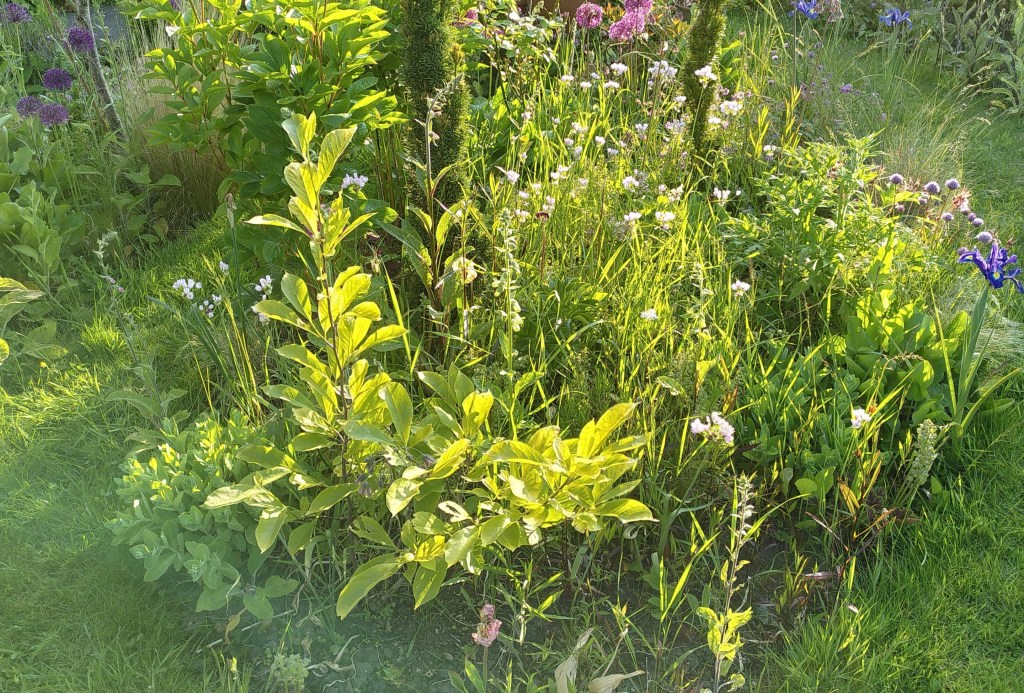
I am struck by how loose my control over my garden really is. At the mercy of weather, pests and disease, there are significant limits to the influence I am able to wield over the process. My intervention might be able to keep a plant healthy, or even hasten its growth, but always with the risk of damage. In this last year I have had very little time for my garden. But the snowdrops still came in February, daffodils in March, tulips in April. The soft fruits are plentiful, foxgloves and nigella have seeded themselves bountifully and the echinops are putting out great thistles. All this has happened in spite of me – I can claim very little credit.

For the most part, gardening is dull and repetitive. What little work I have done over the last year has mostly been weeding – the ultimate war of attrition. Weeding is never done; there will always be some that escape and, without fail, more will have grown back in a week’s time. It would be easy to despair at the futility of it, but you cling on to the hope of summer – you imagine your flourishing borders unencumbered by competing weeds – and somehow that makes the drudgery worth it.

The sentimentalist in me gets pretty disheartened by all of this. I find it easier to like the idea of gardening far more than the actual practice of gardening. It’s easy to idealise the beauty of a well-tended garden and to persuade yourself that it can be achieved with minimal effort or cost. But, like all sentimentalism, this is a recipe for disappointment and disillusionment.

Here it might be helpful to recap James K.A. Smith’s idea of a liturgy. We are what we love: where we focus our desire and how we imagine the good life forms our identity. And our desires, in turn, are shaped by repetitive practices and rituals. Think of how the practice of shopping may train us to desire certain products and to imagine a good life that involves an abundance of possessions, or how the practice of weightlifting may train us to desire a certain body shape and to imagine a good life that involves physical prowess. These identity-forming practices are what Smith calls liturgies.

I think gardening is a liturgy. Or, to take it a step further, I wonder if gardening is best thought of as a counter-liturgy. The idea here is that we are, all of the time, being formed by liturgies. Most of those liturgies are secular liturgies – liturgies which mis-direct our desires towards things other than (and often opposed to) the kingdom of God. Discipleship, says Smith, often attempts to counter these secular liturgies with ideas and beliefs – thinking the right things – which is always doomed to failure because we are not purely rational beings. Instead, we need to counter those secular liturgies with counter-liturgies – practices which re-order our desires towards the Kingdom.

Gardening re-orients my desires in many ways.

The slowness of gardening counters those secular liturgies which train me to hurry, to rush, to compete. It calls into question the story of joyless, restless efficiency and production, and situates me in a better story – of seasons and patience and margin.

The limits of my control over my garden counter those secular liturgies which teach me to be a rugged, sovereign individual – the lonely captain of my fate. It calls into question the story of ever advancing technological innovation ushering in a utopia where all risk (including the perpetual risk of love) is eliminated, and it situates me in a better story – where there is beauty in knowing the limits of my wisdom and foresight. Where community, humility and integrity matter more than conquest, safety and comfort.

The dullness and mundanity of gardening counter those secular liturgies which insist that the only life living is one of spontaneity, self-centred hype, exaggerated achievements and rampant hedonism. It calls into question the story of empty celebrity and the unrealistic expectations of an Instagram-able life, and it situates me in a better story of rhythm and discipline, of humble aspirations, of good honest hard work, and hope of redemption. A story that values the glamourless work of character formation and showing up to reality higher than the synthetic sheen of marketing, relentless maintenance of my personal ‘brand’ and the untethered morality of being ‘true to myself.’

In so many ways, gardening is a counter-liturgy which is transplanting me and my desires from the lifeless, claggy soil of late modern secular culture into the deep, rich loam on the Kingdom. That uprooting is not a given. It’s contested. In the garden, there is always the temptation towards hacks and shortcuts. It is always tempting to squash the redemptive potential by doubling down on those secular liturgies I have been schooled in. But slowly, imperfectly, by the grace of God, I trust that my garden is an arena for counter-liturgy – for transformation.

Review: Restless Devices by Felicia Wu Song

One of the best books that I have read this year is Felicia Wu Song’s Restless Devices: Recovering Personhood, Presence, and Place in the Digital Age. It is a diagnosis of much that is unhealthy with the culture of permanent connectivity that has been proliferated by digital technology. Her assessment never romanticises the past to dismiss the benefits of digital technology, but she outlines clearly and persuasively many of the costs we are (often) uncritically paying as individuals and as society as a result of our digital addiction. There are many parts of what she writes that I would like to explore more. In this article, I’ll focus on her reflections on being human and having limits.

One of Song’s starting points is to dismiss the idea that digital technologies are merely tools – neutral instruments that can be used for good or bad. Instead, she argues that their design privileges certain options. Social media, for example, is designed to captivate our attention and mine us of our data. It does so very successfully because it is designed to be addictive by delivering the emotions we crave rather than the complexity we need to interact healthily with the world. Far from a benign tool, digital technology tells a powerful story about what it is to be human and how we should live together; a story narrated by corporations whose concern is for their profits not our best interests.    

The story that digital technology immerses us in bends our assumptions about what it means to be human. It teaches us to view the very limits that make us human – the limits of our bodies, of time, and of place – as inconvenient restraints to transcend. I will try to briefly summarise each of those.

The digital impacts our relationship with our bodies in many ways – not least in its leaning towards disembodiment. The physical limitations of our bodies are regarded as a nuisance. Living rooted in community with actual in-the-flesh human beings – in particular those ‘others’ who are not like us – is regarded as unnecessary when online connection allows us to self-define who we are in the abstract.

The digital encourages us to transcend the limits of time by at once monopolising our attention (distracting us from the things that really matter) and bombarding us far more opportunities than we could ever have time for. This keeps us in a state of FOMO (fear of missing out) and anxious busyness where virtually all stillness is removed from our lives by a constant urge to check our phones to ensure that we are not missing out. Time becomes a competitor we race against and try (always unsuccessfully) to master.

The digital immerses us in a story that is placeless and displacing, that interacts with the physical world only as potential fodder for our social media profiles, that places no value on rootedness or fidelity to a particular place. Some might say it fosters a nomadic lifestyle, but that is to misunderstand the strong community dynamics in nomadic tribes. Instead, what digital technology fosters is a form of hyper-individualism that masquerades as ‘freedom’ but which in reality is an isolating force severing us from any connection to place or people.


Recently, I re-read The Shepherd’s Life by James Rebanks. It is the beautifully written story of a Lake District Shepherd. The book ends with the haunting line ‘this is my life, I want no other.’ I say haunting because I am struck by how few people I know who could honestly say that of their lives. The digital technology that we are immersed in feeds off and encourages the exact opposite – shaping us into people who long for lives other than the one we are living. That is at the heart of the attempts to transcend the limits of bodies, time and place – it is essentially saying ‘this is my life, and I desperately want another.’ And the tragedy of this drive towards transcendence is that it diminishes the exact things that make for human flourishing. Instead, we are being shaped into disembodied, lonely, angry, narcissistic, frantic, displaced and uprooted people. And this isn’t accidental. The power-brokers of digital capitalism know that disembodied, lonely, angry, narcissistic, frantic, displaced and uprooted people will consume more social media. And so, they hook our attention and sell it to advertisers, at huge profit for them and huge cost to the wellbeing and flourishing of human beings, of local communities, of our politics and our societies.         

We need a better story. That is what Song proposes in the second half of the book. If our digital routines are ‘secular liturgies’ which form our habits, values and imagination, then we must practice ‘counter-liturgies,’ which ground us in a better story. The main practices she outlines are designed to reorient us around the limits of bodies, time and place – and receiving those limits as gifts, rather than as restrains to transcend.

She talks about embodied, faithful presence and the importance of being with others in real physical community – especially those who are not like us. She talks about sabbath as a practice to root us in the gift of time. And she talks about sacred space as a practice that dares us to show up to our place without digital distraction.

These counter-liturgies excite me. They frame spiritual practices as acts of resistance – habits which, through simple repetition and mundane persistence, might just make plausible that elusive line from James Rebanks. I’m not sure about this, but I wonder if a significant test of our faithfulness at making disciples in the digital age, is the extent to which we cultivate the conditions that make it possible for us to honestly declare ‘this is my life, I want no other.’ To that end, I hugely recommend Song’s book to anyone interested in spiritual formation in this cultural moment.