
Tending a garden is slow work. Little can be achieved in a hurry. Germinating, training, ripening, improving the soil – even with the best conditions – requires a lot of waiting. There are few short cuts which do not compromise the long-term health of the garden.
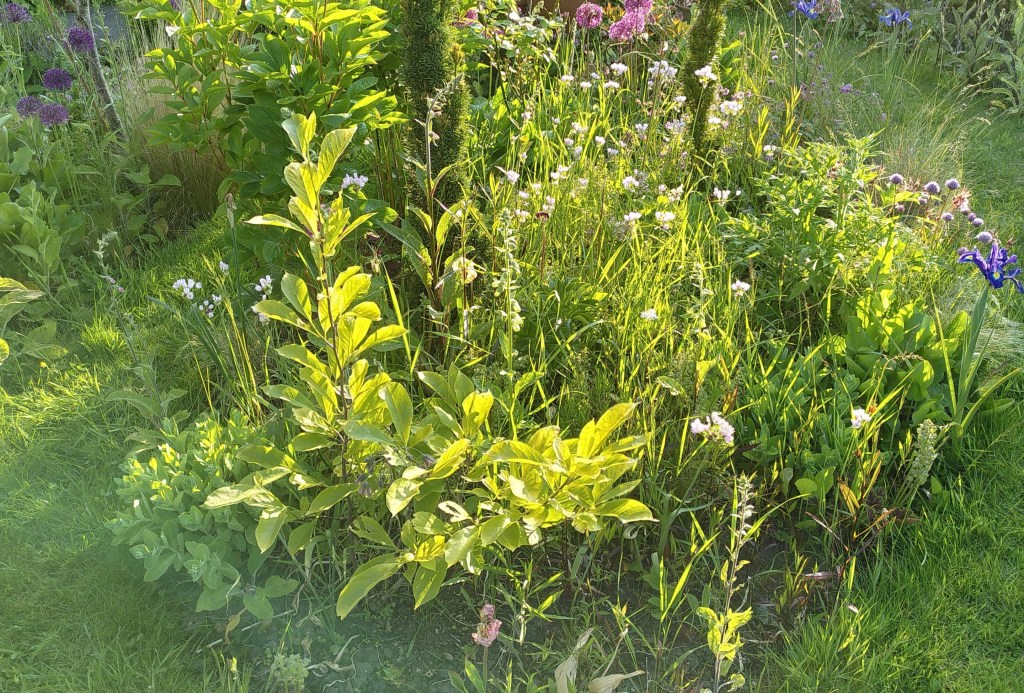
I am struck by how loose my control over my garden really is. At the mercy of weather, pests and disease, there are significant limits to the influence I am able to wield over the process. My intervention might be able to keep a plant healthy, or even hasten its growth, but always with the risk of damage. In this last year I have had very little time for my garden. But the snowdrops still came in February, daffodils in March, tulips in April. The soft fruits are plentiful, foxgloves and nigella have seeded themselves bountifully and the echinops are putting out great thistles. All this has happened in spite of me – I can claim very little credit.
For the most part, gardening is dull and repetitive. What little work I have done over the last year has mostly been weeding – the ultimate war of attrition. Weeding is never done; there will always be some that escape and, without fail, more will have grown back in a week’s time. It would be easy to despair at the futility of it, but you cling on to the hope of summer – you imagine your flourishing borders unencumbered by competing weeds – and somehow that makes the drudgery worth it.
The sentimentalist in me gets pretty disheartened by all of this. I find it easier to like the idea of gardening far more than the actual practice of gardening. It’s easy to idealise the beauty of a well-tended garden and to persuade yourself that it can be achieved with minimal effort or cost. But, like all sentimentalism, this is a recipe for disappointment and disillusionment.
Here it might be helpful to recap James K.A. Smith’s idea of a liturgy. We are what we love: where we focus our desire and how we imagine the good life forms our identity. And our desires, in turn, are shaped by repetitive practices and rituals. Think of how the practice of shopping may train us to desire certain products and to imagine a good life that involves an abundance of possessions, or how the practice of weightlifting may train us to desire a certain body shape and to imagine a good life that involves physical prowess. These identity-forming practices are what Smith calls liturgies.
I think gardening is a liturgy. Or, to take it a step further, I wonder if gardening is best thought of as a counter-liturgy. The idea here is that we are, all of the time, being formed by liturgies. Most of those liturgies are secular liturgies – liturgies which mis-direct our desires towards things other than (and often opposed to) the kingdom of God. Discipleship, says Smith, often attempts to counter these secular liturgies with ideas and beliefs – thinking the right things – which is always doomed to failure because we are not purely rational beings. Instead, we need to counter those secular liturgies with counter-liturgies – practices which re-order our desires towards the Kingdom.
Gardening re-orients my desires in many ways.
The slowness of gardening counters those secular liturgies which train me to hurry, to rush, to compete. It calls into question the story of joyless, restless efficiency and production, and situates me in a better story – of seasons and patience and margin.
The limits of my control over my garden counter those secular liturgies which teach me to be a rugged, sovereign individual – the lonely captain of my fate. It calls into question the story of ever advancing technological innovation ushering in a utopia where all risk (including the perpetual risk of love) is eliminated, and it situates me in a better story – where there is beauty in knowing the limits of my wisdom and foresight. Where community, humility and integrity matter more than conquest, safety and comfort.
The dullness and mundanity of gardening counter those secular liturgies which insist that the only life living is one of spontaneity, self-centred hype, exaggerated achievements and rampant hedonism. It calls into question the story of empty celebrity and the unrealistic expectations of an Instagram-able life, and it situates me in a better story of rhythm and discipline, of humble aspirations, of good honest hard work, and hope of redemption. A story that values the glamourless work of character formation and showing up to reality higher than the synthetic sheen of marketing, relentless maintenance of my personal ‘brand’ and the untethered morality of being ‘true to myself.’
In so many ways, gardening is a counter-liturgy which is transplanting me and my desires from the lifeless, claggy soil of late modern secular culture into the deep, rich loam on the Kingdom. That uprooting is not a given. It’s contested. In the garden, there is always the temptation towards hacks and shortcuts. It is always tempting to squash the redemptive potential by doubling down on those secular liturgies I have been schooled in. But slowly, imperfectly, by the grace of God, I trust that my garden is an arena for counter-liturgy – for transformation.


 Notes From the Potting Shed