
Reflecting on Sabbatical

Having been back at work for a few weeks now, it feels like a good time to reflect on my three-month sabbatical. I came into sabbatical excited but also in quite a cynical and exhausted place. I hoped for a time of deep rest – a slowing down to be present to God and to my family. I wrote in the first week about a desire to go back to the basics – to simply receive and delight in God’s goodness.

So, how did it go? My workplace’s sabbath policy did not require me to accomplish anything to justify my sabbatical. I’ve been hugely grateful for that freedom.  Overall, I have loved this time. Sabbath rest in its various forms is always a gift – God’s gift – which I am grateful to receive. I have loved the simplicity and spaciousness of it. It was precious to have time to play with my son without worrying about getting to the next meeting, time to go for long walks and bike rides, time to read books just because I wanted to read them.

And yet, in many ways, it did not go how I had hoped. Midway through I had to return to work because our funding looked like it was in trouble. I didn’t return full-time, but it meant that the second half of sabbatical was very different from the first – less present and restful, more distracted and stressful and hurried. It felt like my mind, body and soul were just beginning to recover from the toll of a difficult season of work and life, and then I was unexpectedly thrown back in again.

There was definitely some grief there. Grief that my sabbatical was not going to not match up to the years of hopes and dreams I had invested in it. I found myself frustrated at God. In the Hebrew Bible, the practice of sabbath is an act of trust in God’s provision – trusting that God will provide even when we stop work. And, honestly, it felt like God had not kept His side of the deal. There were some hard days processing that disappointment, but I was able to land with some perspective, remembering that sabbatical is a gift, not an entitlement, and a gift that the vast majority of people do not get to enjoy. I could be angry and frustrated that it did not go to plan, or I could make the most of the time that I had. I tried, imperfectly, to choose the latter.

There are no great achievements from my sabbatical – no book, no qualification, no dramatic spiritual breakthrough. I did read quite a few books and got myself a bit fitter. And I think sabbatical has changed me.

Chatting with my spiritual director earlier this week, the theme that kept coming up as we reflected on sabbatical was that I think it humbled me.

Slowing down and being more present at home are lovely in theory, but I found them hard in practice. Maybe for the first time in adult life I could not avoid the question of who I am when I am not working hard and achieving things. I liked to imagine that I was basically quite a kind and patient person, but I was humbled to discover that it only took a few days of childcare or bad sleep or my wife being ill to break that façade. My son is wonderful, but he is two, and that comes with a whirlwind of big feelings and an endless supply of energy. The mundanity of parenting confronted me with my deep selfishness. To my shame, I would catch myself fantasising about how much more fun sabbatical would be without a child.  

The humbling came on other levels too – the humbling of achieving far less than I’d hoped for even after I’d tried to manage my expectations and ambitions, and the humbling of realising that I had not done enough to set my team up to thrive while I was off. It wasn’t what I expected from sabbatical, but at the same time, the humbling was not unwelcome. There haven’t been dramatic moments of spiritual encounter over this time, but I’m confident that God has been at work in me – and I think there is grace in the way that I’ve been confronted with my own weakness and self-reliance.  

I was nervous about returning to work, but I’ve actually really enjoyed returning fully into the swing of things over the last few weeks. Where I was quite tired and cynical in May, I’ve come back with a fresh energy, vision and passion for work. In the final weeks of sabbatical I re-read some of the books that got me excited about a radical pursuit of Jesus and justice when I was an undergraduate and I felt a re-affirmation of vocation – a renewed clarity that this role and this movement is where God is calling me right now. Being confronted with my selfishness has helped me, very imperfectly, to love my wife and my son better. And on a very simple level, I love Jesus more. I’ve been angry at him, for sure, but I’ve also been wooed again by his beauty and goodness. I don’t need to justify sabbatical, but if I did, I’d say those are good outcomes.

I don’t want to try to force a positive spin on this. Parts of it have been really hard, sad and frustrating. But that is the reality of life this side of new creation. Many more parts have been gentle, precious and deeply restful. It may not have been exactly the gift I had anticipated, but it was most certainly a gift.

Setting Out On Sabbatical

My sabbatical has begun. As I’ve spoken to people about it, especially people outside of the church-y world, I’ve noticed that it is a word in need of definition. Either people haven’t heard of a sabbatical before, or maybe they remember their minister taking a year out to do some study, or something more akin to an academic sabbatical. Though I’d be excited by the prospect of study leave, I’ve been convinced that these next three months of sabbatical require a different approach. At its root, sabbatical (like sabbath) derives from the Hebrew shabbat, which means to stop. It is a ceasing from work in order to rest and delight, to re-root my true identity in God, and to resist a culture of overwork, frantic busyness and joyless anxiety. Reading over notes I took from Ruth Hayley Barton’s Embracing Rhythms of Work and Rest, I was particularly struck by these lines:

‘Knowing that sabbatical is a gift from a loving God – and not merely a gift from one’s church or institution – makes quite a difference… Rather than feeling guilty or entitled, I was able to gratefully receive sabbatical as God’s care for me, a beloved child’

I have not struggled to recognise the immense privilege that it is to work for an organisation that has a generous sabbatical policy, and that has allowed me the freedom to design this time according to what I need. But I had, perhaps, been less alert to the basic goodness of God – who wove rhythms of sabbath rest into creation and whose invitation to me in this season is to rest in his goodness.

This last year has been tough. Adopting has been joyful but also the hardest thing we have ever done. I love my job but this has been the toughest year of work I’ve known. Changes in our team, transitioning into our second decade as a movement and financial struggles have presented big challenges. My response to those challenges has been to be strong and rely on hard work. I have taken it upon myself to find solutions and save the day, and as a result I have lived at a pace that is not sustainable or healthy.

As I settle into sabbatical, my temptation is to try to optimise – to freight it with expectations, goals and ambitions. I have drilled myself in a self-centred, industrial mindset that frantically seeks to extract the maximum productivity from every opportunity. If my sabbatical is about stopping work, then I think it will require me to go deep down to the roots and to part ways with this industrial mindset.

I want this sabbatical to be a time of slowing down enough to love others well, of being present and interruptible and unhurried. I want to cultivate what John Swinton calls ‘timefulness,’ an alertness to God’s presence in the every-day and a simple delight.

Perhaps that simplicity is key. I’ve had fads on minimalism but my life over the last year has felt cluttered and complicated. My faith is fragile and distracted. Scandals and frustrations at older leaders I had looked up to have bred a creeping cynicism and distrust. I worry that I am becoming harder, sharper, and more judgemental rather than softer, wiser and kinder.    

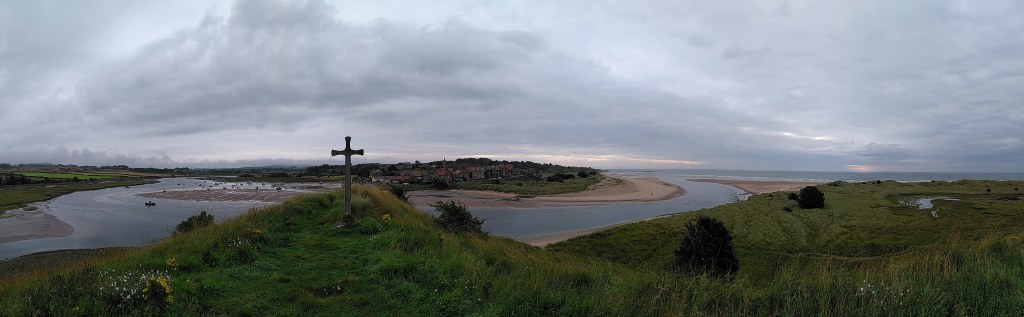
I’m hungry for simplicity. I walked on the beach a few days ago and the words of psalm 23 came to me. I sang it over and over into the wind. If this sabbatical is to have any aim (and I am very cautious of loading it with the goals that my industrial mindset craves) then I think it is this: to go back to the basics. To return again to the Lord who is my shepherd. To strip away the baggage, the ego, the pride, the self-reliance, the frustration, the cynicism, the shame – and to know that I lack nothing, that I need fear no evil, that his goodness and mercy follow me all the days of my life.

This sabbatical is an incredible gift and I want to choose simply to receive – without needing to justify or earn it. I want to simply receive and to delight in God’s goodness. If that is all I do, that will be enough.

Review: Restless Devices by Felicia Wu Song

One of the best books that I have read this year is Felicia Wu Song’s Restless Devices: Recovering Personhood, Presence, and Place in the Digital Age. It is a diagnosis of much that is unhealthy with the culture of permanent connectivity that has been proliferated by digital technology. Her assessment never romanticises the past to dismiss the benefits of digital technology, but she outlines clearly and persuasively many of the costs we are (often) uncritically paying as individuals and as society as a result of our digital addiction. There are many parts of what she writes that I would like to explore more. In this article, I’ll focus on her reflections on being human and having limits.

One of Song’s starting points is to dismiss the idea that digital technologies are merely tools – neutral instruments that can be used for good or bad. Instead, she argues that their design privileges certain options. Social media, for example, is designed to captivate our attention and mine us of our data. It does so very successfully because it is designed to be addictive by delivering the emotions we crave rather than the complexity we need to interact healthily with the world. Far from a benign tool, digital technology tells a powerful story about what it is to be human and how we should live together; a story narrated by corporations whose concern is for their profits not our best interests.    

The story that digital technology immerses us in bends our assumptions about what it means to be human. It teaches us to view the very limits that make us human – the limits of our bodies, of time, and of place – as inconvenient restraints to transcend. I will try to briefly summarise each of those.

The digital impacts our relationship with our bodies in many ways – not least in its leaning towards disembodiment. The physical limitations of our bodies are regarded as a nuisance. Living rooted in community with actual in-the-flesh human beings – in particular those ‘others’ who are not like us – is regarded as unnecessary when online connection allows us to self-define who we are in the abstract.

The digital encourages us to transcend the limits of time by at once monopolising our attention (distracting us from the things that really matter) and bombarding us far more opportunities than we could ever have time for. This keeps us in a state of FOMO (fear of missing out) and anxious busyness where virtually all stillness is removed from our lives by a constant urge to check our phones to ensure that we are not missing out. Time becomes a competitor we race against and try (always unsuccessfully) to master.

The digital immerses us in a story that is placeless and displacing, that interacts with the physical world only as potential fodder for our social media profiles, that places no value on rootedness or fidelity to a particular place. Some might say it fosters a nomadic lifestyle, but that is to misunderstand the strong community dynamics in nomadic tribes. Instead, what digital technology fosters is a form of hyper-individualism that masquerades as ‘freedom’ but which in reality is an isolating force severing us from any connection to place or people.


Recently, I re-read The Shepherd’s Life by James Rebanks. It is the beautifully written story of a Lake District Shepherd. The book ends with the haunting line ‘this is my life, I want no other.’ I say haunting because I am struck by how few people I know who could honestly say that of their lives. The digital technology that we are immersed in feeds off and encourages the exact opposite – shaping us into people who long for lives other than the one we are living. That is at the heart of the attempts to transcend the limits of bodies, time and place – it is essentially saying ‘this is my life, and I desperately want another.’ And the tragedy of this drive towards transcendence is that it diminishes the exact things that make for human flourishing. Instead, we are being shaped into disembodied, lonely, angry, narcissistic, frantic, displaced and uprooted people. And this isn’t accidental. The power-brokers of digital capitalism know that disembodied, lonely, angry, narcissistic, frantic, displaced and uprooted people will consume more social media. And so, they hook our attention and sell it to advertisers, at huge profit for them and huge cost to the wellbeing and flourishing of human beings, of local communities, of our politics and our societies.         

We need a better story. That is what Song proposes in the second half of the book. If our digital routines are ‘secular liturgies’ which form our habits, values and imagination, then we must practice ‘counter-liturgies,’ which ground us in a better story. The main practices she outlines are designed to reorient us around the limits of bodies, time and place – and receiving those limits as gifts, rather than as restrains to transcend.

She talks about embodied, faithful presence and the importance of being with others in real physical community – especially those who are not like us. She talks about sabbath as a practice to root us in the gift of time. And she talks about sacred space as a practice that dares us to show up to our place without digital distraction.

These counter-liturgies excite me. They frame spiritual practices as acts of resistance – habits which, through simple repetition and mundane persistence, might just make plausible that elusive line from James Rebanks. I’m not sure about this, but I wonder if a significant test of our faithfulness at making disciples in the digital age, is the extent to which we cultivate the conditions that make it possible for us to honestly declare ‘this is my life, I want no other.’ To that end, I hugely recommend Song’s book to anyone interested in spiritual formation in this cultural moment.

Unsporting: giving up the consumption of sport

Photo by Torsten Dettlaff from Pexels

In Sabbath as Resistance, Walter Brueggemann writes about the restless anxiety and violent competitiveness that proliferates in society. ‘The totem,’ he says, ‘of such restlessness is perhaps professional sports … The endless carnival of those sports constitutes a dramatic affirmation of power, wealth, and virility in which “victory” is accomplished by many abusive exploitations, all in pursuit of winning and being on top of the heap of the money game.’[1]

When I first read it a few years ago I mostly dismissed it. This, I thought, is probably a bit of an American thing that doesn’t really apply to me. Surely, I can enjoy a bit of professional sport and still practice sabbath, still resist the culture of restless anxiety and live into God’s alternative values of neighbourliness, justice and rest.

But something from my initial reading clearly lodged in my mind and it has come to the fore over the last few weeks. We’ve had quite a summer of sport – the football, the rugby and the Olympics have all drawn me in. I’ve had excited conversations with friends, eagerly awaited player ratings and team selections, watched analysis and read punditry – all of it on a level that I don’t remember doing before.

I’ve tried to be sensible and retain some boundaries, particularly around work, but that has simply meant that my rest and weekends this summer have largely been dominated by the consumption of ‘the endless carnival’ of professional sport. I do not think that is necessarily a bad thing in itself and there certainly have been moments that I have enjoyed. But there have increasinly been moments where I have wondered about the influence this is all having on me. If we become what we give our attention to, then how is this consumption of sport shaping me? Who is it forming me into?

My relationship with sport has always been a little complicated. Growing up, I got fairly seriously into a number of sports. But I don’t know if I’ve ever really enjoyed playing sport. I enjoyed the winning, but I’m not sure I especially enjoyed the playing in a purer sense. The angry tears that would often come if I made a mistake on a football pitch may just about be a thing of the past, but that unpleasant competitive edge has carried from playing sport as a teenager into the more vicarious world of consuming professional sport as an adult. For whatever reasons, I seem to have especially struggled this summer. When England lost the Euros and when the Lions lost the test series my sleep was affected for days. What does it say about my priorities when I don’t lose a wink of sleep over a drug overdoses on our estate, but a few jaw-droppingly wealthy men, a ball and the inevitable ability to over-promise and under-deliver can wreck my body’s rhythms?

The capacity professional sport has to affect my mood and command my attention worries me. And so does the anger that I’ve felt – whether directed at players, coaches, officials or other nations. Again, the questions come: ‘who is this forming me into?’ ‘what in me is being appealed to here?’ Surely what is being appealed to are ugly, broken, unkind parts of me that need deep work, not casual encouragement. Surely, I am not being formed into a person of love, character, depth and integrity. Instead, I am being formed into someone who is angry, tribal and distracted – abdicating from the risk and pain of engaging meaingfully in the reality of the world and instead vicariously simulating that risk and pain through the narcotic satiation of commodified sport.

So, I have a bit of a decision to make. Do I look for ways to engage with professional sport more healthily? Or do I do something a little more extreme and abstain? I’ve tried not watching matches live but find that I just end up anxiously refreshing the live updates on BBC which may only be marginally less stressful and distracting.

And so, reluctantly, I want to experiment with something more severe. If Brueggemann is right, (it’s probably time I admitted that he might be onto something) then the practice of sabbath is the appropriate resistance to the competition, consumption and distraction glorified by professional sport. So, it is time for a sabbatical – a fast – a divestment from a form of entertainment that has been a significant part of my life for as long as I can remember.

I don’t like who I become when I consume sport. It brings out the worst in me, not the best. This might not be the solution – it could be an overreaction, but in the absence of better ideas I think this is worth a try. For the rest of this year, I am committing to be deliberately inattentive to scorelines, headlines, transfer rumours and highlights.    

I will give some thought to what I do instead – old habits die hard so I am not expecting this to be easy. I expect it will be helpful to see this less as giving up something I quite like, and more as choosing something better.

‘Sabbath is a practical divestment so that neighbourly engagement, rather than production and consumption, define our lives.’

Walter Brueggemann, Sabbath as Resistance, 18

[1] Walter Brueggemann, Sabbath as Resistance: Saying No to the Culture of Now (Louisville: John Knox Press, 2017), pp. 15-16